Setting the Stage for Breathable Luxury Kitchens
Why Spring Remodels Demand Fresh Air Strategies in South Florida
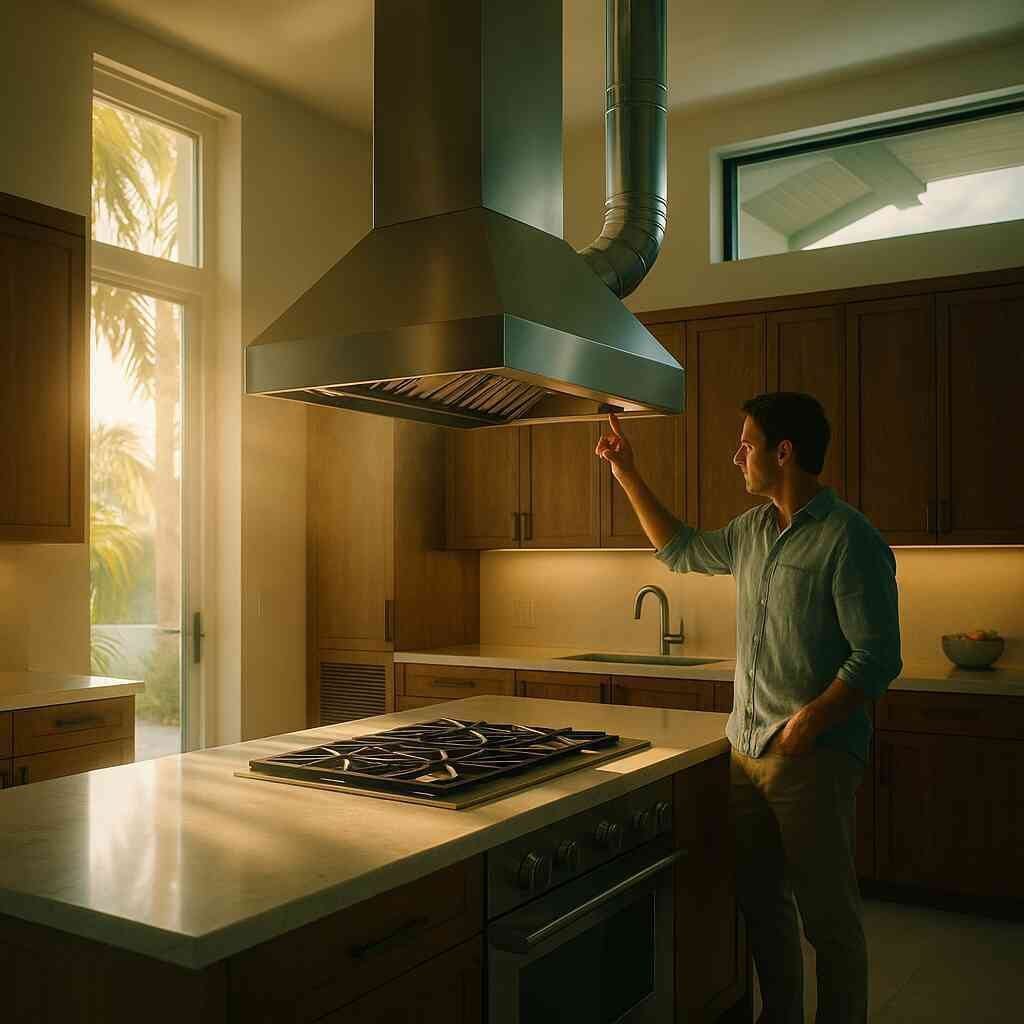
The humid coastal climate pushes cooking odors deep into cabinetry when ventilation is ignored. Spring remodeling therefore begins with airflow calculations, not backsplash colors. Thoughtful fresh air planning prevents moisture from condensing on new quartz counters while also keeping pollen at bay. Homeowners quickly discover that a beautiful kitchen without clean air feels unfinished. RENOVA’s designers place return grilles and roof caps on the first sketch so beauty and breathability arrive together.
A regional surge of outdoor grilling during spring amplifies smoke migration indoors. Properly sized range hoods intercept these vapors before they tarnish stainless fixtures. Balanced make-up air keeps doors from slamming when exhaust fans run at full speed. Our renovation contractor team models these pressure shifts using industry software. The result is a kitchen that smells like seared tuna during dinner but like ocean breeze by sunrise.
The RENOVA Advantage with a Licensed General Contractor at the Helm
Every vent run hides inside framing that must still pass structural review. A licensed general contractor oversees carpenters, electricians, and HVAC mechanics so no trade blocks another. That coordination ensures ducts stay straight, minimizing static pressure and future noise. On-site supervisors track deliveries, staging each elbow and damper exactly when the framer opens the chase, which reduces drywall patches and accelerates inspections.
Homeowners also gain a single point of accountability when code questions arise. Our permit expeditor submits sealed drawings alongside airflow calculations, sparing clients surprise change orders. Field adjustments occur in real time because the project manager holds authority over every subcontractor. This seamless chain of command, backed by premier general contractor services in South Florida, produces reliable timelines and stress-free walkthroughs.
How Delray Beach Kitchen Ventilation Code Safeguards Indoor Air Quality
Local amendments to the Florida Building Code require range hoods to vent outdoors, not into attics. The Delray Beach kitchen ventilation code further restricts recirculating products in new construction. By mandating grease filters plus smooth, corrosion-resistant ducts, officials lower fire risk while capturing airborne particulates. Continuous mechanical ventilation also reduces carbon monoxide buildup from gas cooktops.
Because enforcement tightens each year, trusted remodelers pre-assemble compliance packets for plan reviewers. Our documents illustrate termination heights above sloped tile roofs and show how backdraft dampers protect conditioned space. When homeowners understand that these rules preserve their family’s respiratory health, permitting feels like an investment, not a bureaucratic hurdle.
Decoding Palm Beach County Kitchen Vent Regulations
Florida Residential Kitchen Vent Requirements Every Homeowner Should Know
Statewide code calls for a minimum capture speed of 100 CFM per linear foot of cooktop. Range hoods must exhaust through dedicated ducts and never share lines with bath fans. Accessible clean-outs must appear at each duct offset for annual maintenance. Roof terminations require gravity dampers designed to close when fans stop.
Palm Beach County adopts these basics but layers stricter testing requirements on top. Pressure balancing, measured with a digital manometer, must prove that fresh air supply equals exhaust within 10 percent. RENOVA technicians perform these tests before drywall so corrections remain easy and inexpensive. Clients receive documented proof, which streamlines the final inspection.
Palm Beach County Exhaust Hood Rules and Range Hood Lighting Mandates
Ventilation devices must include integrated, dimmable lighting rated for damp locations. Heat lamps cannot double as task lighting because they skew wattage calculations under energy codes. County amendments cap sound levels at 70 decibels measured three feet from the hood on high speed. To meet that target, RENOVA specifies dual inline blowers mounted in attics rather than inside hood canopies.
Lighting color temperature also matters for visual accuracy when plating food. Warm 3000-K LEDs reduce eye strain and satisfy code language requiring a color rendering index above 80 CRI. Remodeling expertise in Delray Beach on kitchen airflow helps homeowners choose fixtures that complement pendant lighting over islands without violating electrical clearances.
Stainless Steel Ductwork and Grease Duct Standards for Fire Safety
Residential ducts over 400 CFM must use 22-gauge stainless or 18-gauge galvanized steel. Joints receive liquid-tight welds rather than foil tape, preventing grease seepage. Ninety-degree turns count toward equivalent length limits, so RENOVA designers prefer long-sweep elbows. Clean-outs every 12 feet allow fire marshals to verify that interior surfaces remain free of combustible buildup.
Where ducts pass through combustible framing, a one-inch air gap or a listed fire-stop sleeve is mandatory. Our carpenters frame chases slightly oversized, giving mechanical crews room to maintain continuous clearance. This collaborative framing-plus-duct approach eliminates the temptation to compress insulation against hot metal surfaces.
Achieving a Code-Compliant Range Hood Installation with Low-Noise Goals
Homeowners want whisper-quiet operation even during high-heat searing sessions. RENOVA reduces noise by upsizing duct diameters, cutting velocity without sacrificing capture. External blowers on the roof further distance motor hum from living spaces. Flexible acoustic collars between rigid ducts and hood collars also absorb vibration effectively.
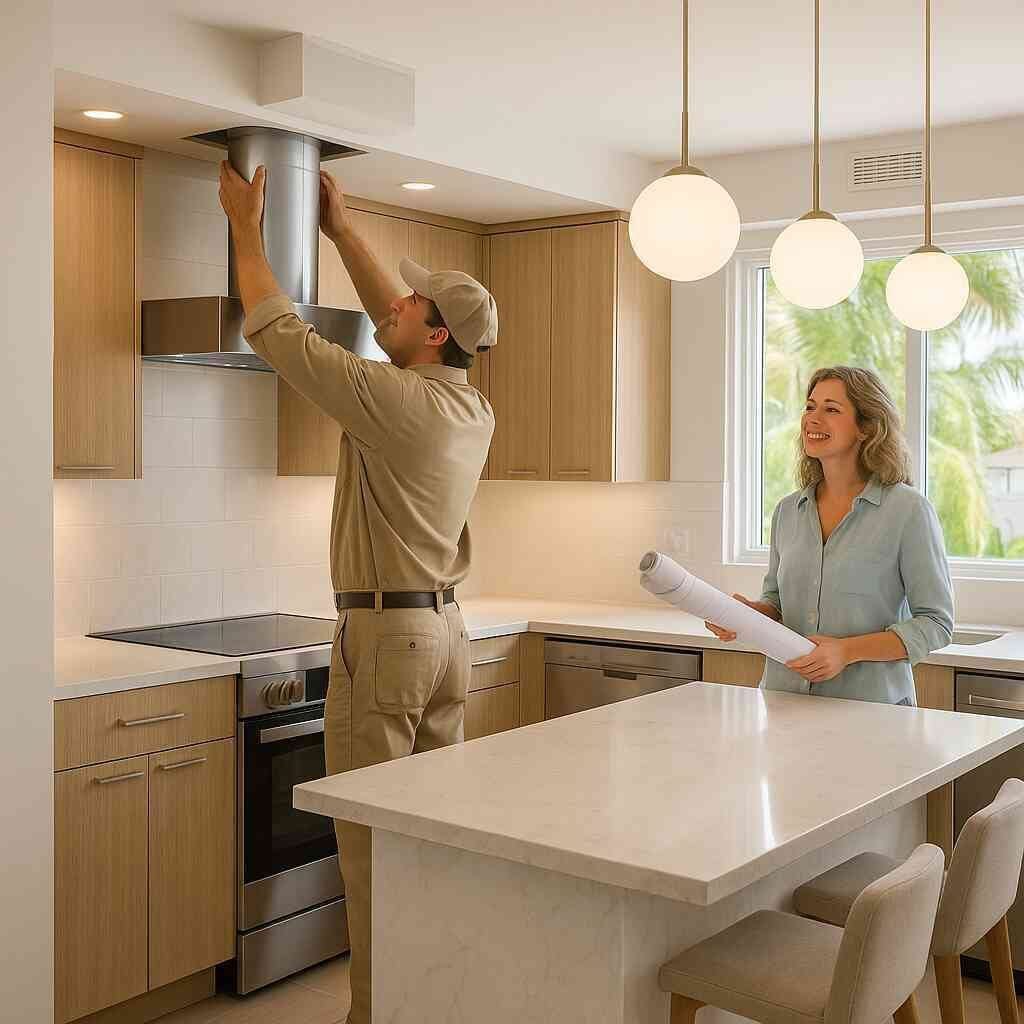
Because county code measures sound inside the kitchen, we perform on-site tests using calibrated decibel meters. Tweaks such as adjusting fan speed curves or adding elastomer gaskets often achieve compliance without aesthetic compromise. Range hood code support near Boca Raton renovations illustrates these solutions for clients comparing equipment brands.
Engineering Airflow Excellence in Custom Homes
Mechanical Ventilation CFM Calculation and Proper Duct Sizing Guidelines
Load calculations start with burner BTUs, ceiling height, and kitchen volume. RENOVA engineers apply the industry formula: CFM equals BTUs divided by 100. We then add a 25-percent safety margin to account for South Florida’s dense humidity. Proper duct sizing follows a friction-rate chart that balances velocity against noise.
When homeowners choose a showpiece 48-inch range, we typically recommend 10-inch round or 3-by-10-inch rectangular ducts. These dimensions keep airspeed below 900 FPM, minimizing grease adhesion. Our field crew marks joist locations on subfloor decking so sheet-metal installers can drill without compromising structural members.
Energy-Efficient Make-Up Air System Design for Open Floor Plans
Open-concept layouts demand balanced airflow; otherwise, powerful hoods pull conditioned air from bedrooms. We integrate electronically controlled dampers tied to range-hood relays. When the cooktop ignites, make-up air fans throttle up gradually, preventing sudden drafts. Heat recovery ventilators temper incoming air, maintaining energy efficiency throughout the home.
In luxury homes, we conceal these units in soffits above pantry corridors, preserving ceiling aesthetics. Automated dampers shut after a time delay, conserving energy during low-heat simmering. Palm Beach County-compliant upgrades in Boynton Beach homes highlight how make-up air improves comfort in waterfront properties.
Smart Vent Controls and Eco-Friendly Materials for Modern Kitchen Upgrades
Wi-Fi-enabled controls let homeowners schedule ventilation cycles from their smartphones. Carbon dioxide sensors trigger fresh air exchanges during large family gatherings. RENOVA specifies duct liners made from recycled aluminum, reducing embodied carbon. We avoid PVC components near heat sources and choose silicone-free gaskets certified for low VOC emissions.
Smart systems also integrate with whole-home automation platforms, closing motorized windows when rain approaches. Firmware updates push new energy-saving modes wirelessly, future-proofing the investment. Our clients appreciate that sustainability and convenience coexist without sacrificing code compliance.
Low-Noise Mitigation Strategies That Delight Interior Designers
Interior designers value acoustics as highly as finishes and colors. RENOVA positions inline blowers between joists packed with mineral wool to dampen vibration. We wrap metal ducts with mass-loaded vinyl inside furred chases. Decorative shrouds extend past the fan intake, diffusing turbulence before it reaches the listening zone.
These tactics allow homeowners to host gatherings in adjacent great rooms while cooking at full capacity. Because county inspectors test hoods on the highest setting, our acoustic solutions must perform under worst-case airflow. Designers specify millwork and finishes, while engineering handles measured noise – and with RENOVA, both goals are met simultaneously.
Integrating Ventilation with Home Additions and Whole-Home Renovations
Home additions complicate airflow because new roofs alter vent routing. RENOVA’s construction managers use 3-D point clouds to map existing duct paths before demolition. Those scans inform framing changes, preventing later conflicts with rafters or skylights. We size dedicated electrical circuits for upgraded blowers during early rough-in, avoiding costly panel replacements later.
Whole-home renovations allow a central energy recovery ventilator to serve multiple wet rooms. Kitchen hoods still run independently, yet their make-up air ties into the ERV system, equalizing pressures throughout the residence. Whole-home permit guidance in West Palm Beach projects demonstrates these integrated strategies across expansive floor plates.
Permitting Pathways and Inspection Success
Construction Permit Checklist – Delray Edition for a Seamless Remodel
Our checklist begins with notarized owner authorization, followed by two stamped mechanical plan sets. We attach airflow calculations, equipment spec sheets, and roof termination diagrams. Next comes a fire-resistance schedule detailing duct clearances and sleeve ratings. Finally, we include energy compliance forms outlining make-up air damper efficiency.
Submitting a complete packet shortens plan review because reviewers do not need to issue clarification requests. Clients sign electronic documents through secure portals, eliminating paper shuttling. Thorough organization translates to faster demolition starts and predictable move-in dates.
Insights from South Florida General Contractors on Mechanical Inspections
Field inspectors prefer visible duct labeling showing gauge, diameter, and UL listing. RENOVA crews stencil this information near clean-outs in contrasting paint. Inspectors also appreciate pre-positioned attic ladder placement, granting safe access to inline blowers. Clean work areas and clear lighting convey professionalism and often speed approval.

Because codes evolve, our superintendents attend monthly building department roundtables. This rapport lets us anticipate policy shifts such as new decibel testing procedures. Strong relationships transform inspections from adversarial encounters into collaborative reviews, saving homeowners both time and money.
Avoiding Building Inspector Red Flags at Roof Termination Caps
Improper flashing remains the leading cause of failed inspections. RENOVA seals caps with high-temperature silicone rated for hurricane zones rather than generic sealant. We extend standing-seam metal pans beneath shingle layers, directing water away from penetrations. Inspectors also reject screens that clog with grease; instead, we install code-approved external backdraft dampers.
Termination height must exceed the roof surface by at least 24 inches to clear turbulent boundary layers. Our crews verify this dimension from the ladder before requesting inspections, preventing repeat trips. Photographs accompany inspection requests, offering transparency to officials in advance.
Commercial Kitchen Code Crossover Tips for Gourmet Residential Projects
Clients who favor restaurant-grade ranges often request commercial hoods. These units demand higher capture velocities and welded grease ducts. RENOVA adapts designs using UL-listed residential equivalents that maintain aesthetic appeal without triggering commercial fire suppression requirements. We add washable baffle filters to mimic professional kitchen functionality while meeting residential code.
Heat-sensor-activated make-up fans borrowed from commercial kitchens can also serve large homes. However, residential electrical panels may lack spare amperage. Our engineers perform load calculations early and resize service feeders when necessary, avoiding last-minute utility upgrades.
Coordinating Timelines with Other Construction Management Milestones
Duct rough-in follows framing but precedes plumbing vent stacks to avoid clashes. Countertop templating waits until hood framing is complete, ensuring centered symmetry. RENOVA’s Gantt charts list vent installation alongside insulation inspections, flagging dependencies. Delays in any predecessor task automatically update client portals with revised delivery dates.
We also track lead times for custom hood liners, often eight to ten weeks out. Early selection keeps the critical path intact. Construction management services for mechanical inspections near Delray showcase our scheduling dashboards, giving homeowners real-time progress views.
Future-Ready Kitchens with RENOVA Craftsmanship
From Plan Review to Final Sign-Off with the Best Contractors Near You
Our team shepherds each project from concept sketches to ribbon-cutting. Dedicated project managers maintain continuous contact through secure mobile apps. Clients receive photo updates and inspection results within minutes of completion. Transparent reporting keeps everyone aligned and eliminates surprises along the way.
Because we self-perform key trades, we control both speed and quality. Handoffs between framers, electricians, and HVAC crews happen under one roof, reducing miscommunication. Code-ready kitchen renovation services at RENOVA illustrate this turnkey approach across dozens of successful projects.
Tracking Building Code Updates to Keep Your Kitchen Ahead of the Curve
Building codes evolve alongside appliance technology and climate realities. RENOVA’s in-house compliance committee reviews proposed amendments each quarter. We adjust standard details to ensure today’s remodel passes tomorrow’s inspection. Clients therefore enjoy future-proof kitchens that preserve resale value over the long term.
Our blog distills complex code language into homeowner-friendly articles, giving you proactive knowledge long before regulations take effect. West Palm Beach kitchen code insights for 2026 upgrades demonstrates how early awareness shapes smarter design decisions.
Partnering with RENOVA for Code-Compliant, Energy-Efficient Kitchen Dreams
Ventilation touches structure, energy, safety, and comfort, so choosing an experienced partner matters. RENOVA unites licensed general contractors, mechanical engineers, and interior designers under one brand. That collaboration delivers kitchens that draw in fresh ocean air while exhausting culinary smoke discreetly. Our craftsmanship enhances luxury while hidden systems run silently in the background.
Ready to breathe easier? Schedule a consultation and watch your dream kitchen move from paper to performance. Decoding South Florida building codes for kitchen vents reveals more insights and invites you into the RENOVA family.
Frequently Asked Questions
Question: How does RENOVA ensure a code-compliant range hood installation that meets the Delray Beach kitchen ventilation code during my spring remodel?
Answer: Our licensed general contractor team begins every Delray Beach kitchen renovation by calculating the required capture speed – at least 100 CFM per linear foot of cooktop, as outlined in the Florida residential kitchen vent requirements. We then size stainless steel ductwork, specify backdraft dampers, and design a dedicated roof termination cap positioned 24 inches above the roof surface. Before drywall, RENOVA technicians pressure-balance the system and document results for the building inspector. This end-to-end approach delivers a fully code-compliant range hood installation while protecting indoor air quality and fire safety.
Question: The RENOVA Guide to Delray Spring 2026 Kitchen Vent Codes stresses make-up air – how do you create an energy-efficient kitchen make-up air system for open floor plans in Palm Beach County?
Answer: Open-concept layouts can suffer from negative pressure when powerful exhaust hoods run. RENOVA integrates electronically controlled dampers tied to the range hood relay. As soon as the fan starts, tempered make-up air enters through a quiet inline fan, keeping pressures within 10 percent of neutral – exactly what Palm Beach County exhaust hood regulations require. We often pair this with a heat recovery ventilator so incoming air is pre-conditioned, boosting energy efficiency while maintaining comfort throughout your custom home.
Question: What steps appear on RENOVA’s construction permit checklist for a Delray kitchen remodel, and how do you help homeowners avoid building inspector red flags?
Answer: Our construction permit checklist for Delray includes notarized owner authorization, stamped mechanical plans showing proper duct sizing guidelines, airflow calculations, equipment spec sheets, and roof termination diagrams. We label ducts with gauge, diameter, and UL listing in contrasting paint and pre-install safe attic ladders for easy inspection access. By presenting complete, easy-to-read documentation, we minimize plan review comments and eliminate common red flags such as missing clean-outs or inadequate flashing, ensuring a smooth path from demolition to final sign-off.
Question: I want a whisper-quiet kitchen – what low-noise range hood solutions does RENOVA recommend?
Answer: We combine several noise mitigation strategies. First, we upsize ducts to 10-inch round or 3-by-10-inch rectangular, reducing velocity without sacrificing capture. Second, we locate dual inline blowers in the attic to distance motor hum from the cooking zone. Flexible acoustic collars and mass-loaded vinyl wraps further dampen vibration. All solutions are tested with a calibrated decibel meter to confirm the county-mandated 70 dB limit is met, giving you a serene cooking environment that delights interior designers and homeowners alike.
Question: Can RENOVA coordinate kitchen vent upgrades with other home additions so my house stays ahead of South Florida building code updates?
Answer: Absolutely. As a full-service Delray Beach general contractor, we use 3-D scans to map existing systems before any home addition or whole-home renovation. This allows us to reroute ducts around new rafters, integrate central energy recovery ventilation, and size electrical service for future appliance upgrades. Our in-house compliance committee tracks South Florida building code updates, so your kitchen ventilation will remain compliant and energy efficient for years to come.